Vercodax
Layer Collection
Layer Collection
Couldn't load pickup availability
Self-paced learning overview
- 💻 Digital course file available after purchase
- 📚 Learning materials available for long-term use
- 🔒 Secure checkout
- 🧩 Content updated in 2026
1. Problem Statement
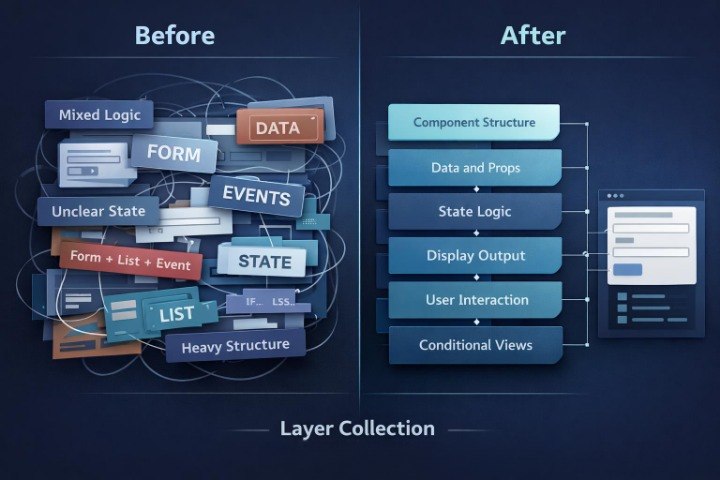
Struggling to understand how different React layers work together inside one interface? You're not alone. When a learning example includes several components, lists, forms, conditional blocks, and states, it can be difficult for students to see which part is responsible for what. One layer may handle data, another may handle display, while another may handle user actions or state updates. When these layers are not separated in the learning logic, the interface can feel overloaded and difficult to read. Layer Collection was created to help students view a React interface not as a chaotic set of parts, but as an organized system of layers.
2. Solution
This course will teach you how to study React interfaces through component layers, state layers, display layers, and interaction layers. Layer Collection explains how to divide responsibility between parts of a learning interface, see the connection between data and display, and understand how events and forms affect the overall structure. Students work with examples where several topics come together in one learning scenario. The course helps students read code more carefully, find the role of each block, and see how changes in one layer affect another. The materials are presented without exaggerated claims, with a focus on order, practice, and sequential study.
3. What’s Inside
- Module 1: Layered Interface Thinking — students learn how to view an interface through several levels: component structure, data, state, display, and interaction.
- Module 2: Component Responsibility — this module explains how to define what each component is responsible for, how not to mix several roles in one block, and how to keep a learning example understandable.
- Module 3: State Layer Practice — students work with examples where state controls display, element selection, forms, or changes in several interface parts.
- Module 4: Display Layer Logic — this module shows how data becomes visual blocks: lists, cards, messages, empty states, and active elements.
- Module 5: Interaction Layer — students review how user actions start interface changes, how events are connected with state, and how to trace their path.
- Module 6: Form and Input Layer — this module introduces learning work with forms, input fields, local state, value changes, and display of entered data.
- Module 7: Conditional Layering — students learn how conditional rendering can work on different interface levels: messages, lists, buttons, sections, or item details.
- Module 8: Layer Practice Scenario — a practice block where students create a learning interface with several component levels, a form, a list, states, and conditional logic.
- Module 9: Code Reading Notes — materials for careful reading of learning code: how to find each layer’s role, how to see dependencies, and how to analyze interface change after action.
- Module 10: Layer Review — a summary module for reviewing component structure, state, display, interaction, forms, and conditional logic as parts of one system.
4. Who is this for?
✅ Fits you if you...
- have already worked with components, props, state, lists, and forms;
- want to better understand the layered structure of React programming;
- need practice combining several topics in one learning interface;
- want to read code more carefully and see the role of each part;
- value sequential materials without loud claims.
❌ Not for you if...
- you are not yet familiar with basic components and state;
- you need only a short introductory course;
- you do not plan to work with practical tasks;
- you are looking for financial or career-related claims;
- you need topics unrelated to learning interfaces.
5. What You’ll Learn
- how to view a React interface through several learning layers;
- how to define component responsibility;
- how state affects different interface levels;
- how data becomes lists, cards, and messages;
- how events start changes in other parts;
- how to work with forms and input fields;
- how to use conditional rendering in different sections;
- how to combine component structure, state, lists, and forms;
- how to read code with several dependencies;
- how to analyze a learning interface as a system of connected layers.
6. Return Terms
Layer Collection includes a 30-day return policy according to Vercodax store terms. If the materials do not match the student’s expectations, they can contact the support team within this period. The request is reviewed according to store rules, purchase date, and material usage terms.
1. Who are Vercodax plans created for?
1. Who are Vercodax plans created for?
Vercodax plans are created for students who want to study React programming through structured courses, practical materials, and organized modules. Each plan has its own topic depth, examples, and learning tasks.
2. Can I start without much development experience?
2. Can I start without much development experience?
Yes, some plans are suitable for an introductory learning path. The materials are organized so students can gradually move from basic concepts to more detailed learning scenarios.
3. What is included in Vercodax courses?
3. What is included in Vercodax courses?
The courses include lessons, modules, interface structure examples, self-study tasks, component logic explanations, review materials, and topic-based practice blocks.
4. Can I choose a plan for my own learning pace?
4. Can I choose a plan for my own learning pace?
Yes, the plans differ by content volume and topic depth. A student can choose the format that fits their learning rhythm, current knowledge level, and preferred material scope.
Share